Most junior technique problems aren’t really technique problems — they’re grip problems wearing a disguise. The grip is the only connection between your kid and the racquet, so when it’s wrong, everything downstream compensates: the swing gets loopy, the wrist gets flippy, the elbow starts aching. Here are the five grip mistakes I see most in junior tennis, how to spot each one, and how to fix it.
Mistake 1: Volleying with a forehand grip
The mistake: Your kid runs to net holding their semi-western forehand grip. The forehand volley is okay; the backhand volley is a panicked stab with a wide-open face.
How to spot it: Watch the backhand volley in a match. If the racquet face is pointing at the sky and balls float long, the grip never changed from the baseline.
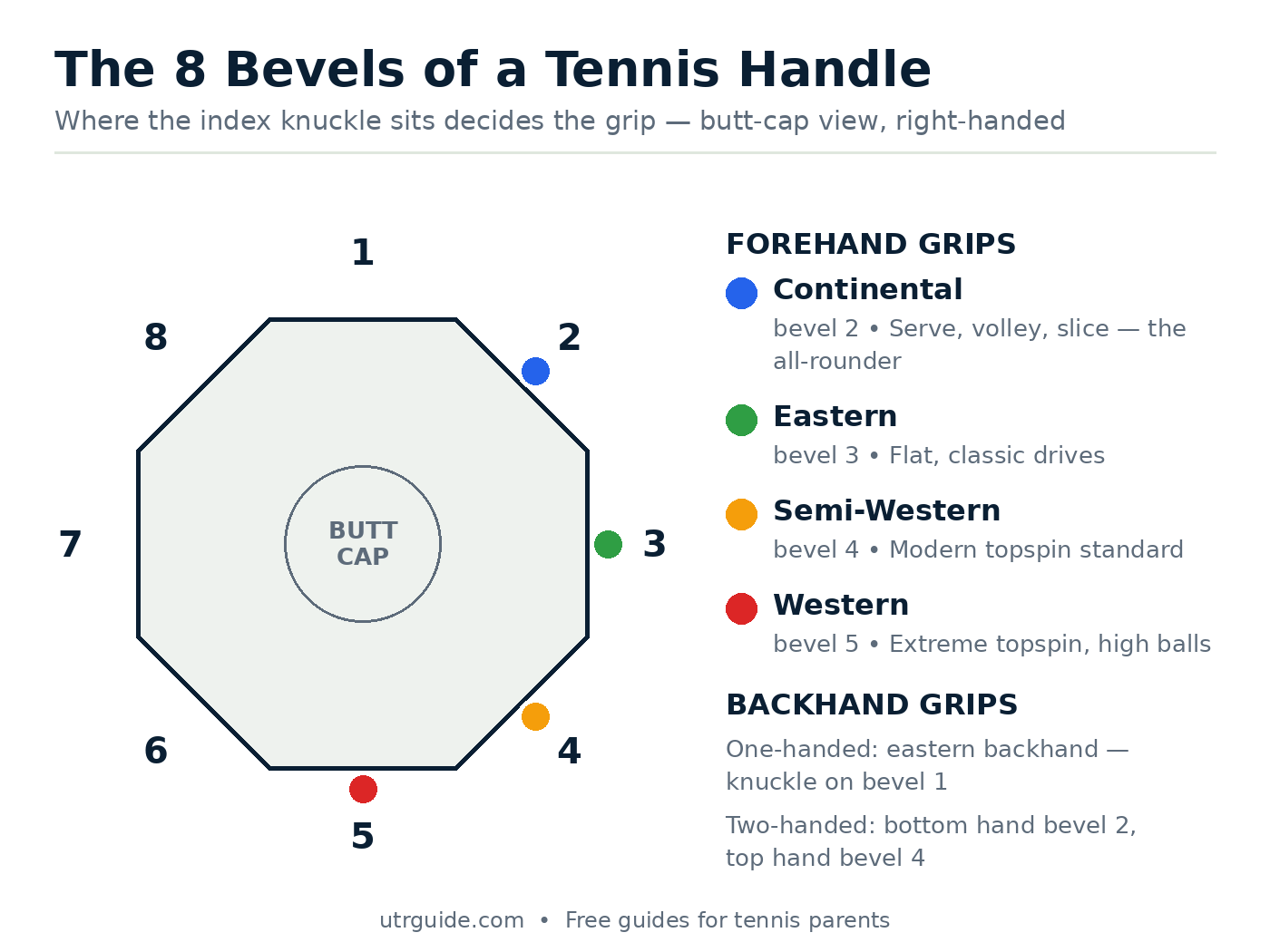
The fix: Continental for everything at net — bevel 2, the handshake grip. Drill it with close-range volley-volley rallies where there’s literally no time to switch. Our continental guide has the full drill set →
Mistake 2: Serving with an eastern forehand grip
The mistake: The hand rotates from continental toward an eastern forehand grip during the toss — “grip creep.” It feels more powerful, so kids do it instinctively.
How to spot it: Flat serves with no snap, lots of faults long, or a serve motion that looks like a “push.” Check the index knuckle at the trophy position: if it’s on bevel 3 instead of 2, there’s your answer.
The fix: The handshake check before every serve in practice — show the grip, name the bevel, then toss. Boring, deliberate, and it works within two weeks.
Mistake 3: The grip that wanders mid-rally
The mistake: The grip is perfect in the living room and migrates two bevels under match pressure. This is the most common grip issue in junior tennis and the least diagnosed, because parents check the grip before the match and never during it.
How to spot it: Watch the index knuckle between points, not during them. If the hand has rotated and your kid doesn’t seem to know, the grip isn’t automatic yet.
The fix: Reps, not lectures. The grip becomes automatic somewhere around a few thousand correct repetitions. Shadow swings at home — 50 a day with the correct grip — do more than any pep talk. Be the wall: curious about what you see, never critical of it.
Mistake 4: Choking up (or down) without knowing it
The mistake: The hand slides up the handle toward the throat for “control” or dangles off the butt cap for “power.” Both change the effective grip and the leverage, usually without the kid realizing.
How to spot it: Look at where the pinky sits. The base knuckle of the pinky should be at or just above the butt cap flare. If there’s a finger’s width of handle showing below the hand, they’ve choked up.
The fix: A single wrap of overgrip in a different color at the correct hand position gives a tactile landmark. Kids self-correct surprisingly fast when they can feel the right spot.
Mistake 5: Death-gripping the handle
The mistake: Squeezing at 10/10 tension on every shot. A tight grip locks the wrist, kills racquet-head speed, and is the classic precursor to arm and elbow soreness in juniors.
How to spot it: White knuckles are the obvious tell. The subtler one: the wrist never lays back and snaps through — the whole arm swings as one stiff lever.
The fix: The 1-to-10 scale. Have your kid hold the racquet at a 3 — firm enough that it won’t fly out, loose enough that you could slide a finger under theirs. Practice rallies at “3” until loose becomes the default. Power in tennis comes from a relaxed whip, not a clenched fist.
The 30-second grip audit
Once a month, run this check — it takes half a minute:
- Index knuckle on the correct bevel for each shot? (Use our 60-second grip finder if you’re unsure.)
- Continental at net and on the serve?
- Hand position consistent — pinky at the butt cap?
- Grip pressure at a 3, not a 10?
- Does the grip survive pressure, or wander mid-match?
Five yeses and the grip is doing its job. Any no is a cheap, fixable upgrade — the best kind of improvement in junior tennis.
Not sure what you’re seeing in your kid’s hand? Upload a 10-second clip to our free Virtual Coach — the AI grip analyzer identifies the grip from video and tells you whether it fits the stroke, with three practical fixes.


Leave a Reply