Ask a junior what grip they use and you’ll hear about their forehand. Ask what grip they volley with and you’ll often get a blank stare. The continental grip — bevel 2, the humble “handshake” grip — is the most under-practiced and most important grip in junior tennis. Serves, volleys, overheads, slices, drop shots: one grip runs the entire net game and the entire serve. Here’s how to make sure your kid actually owns it.
How to find it: the handshake method
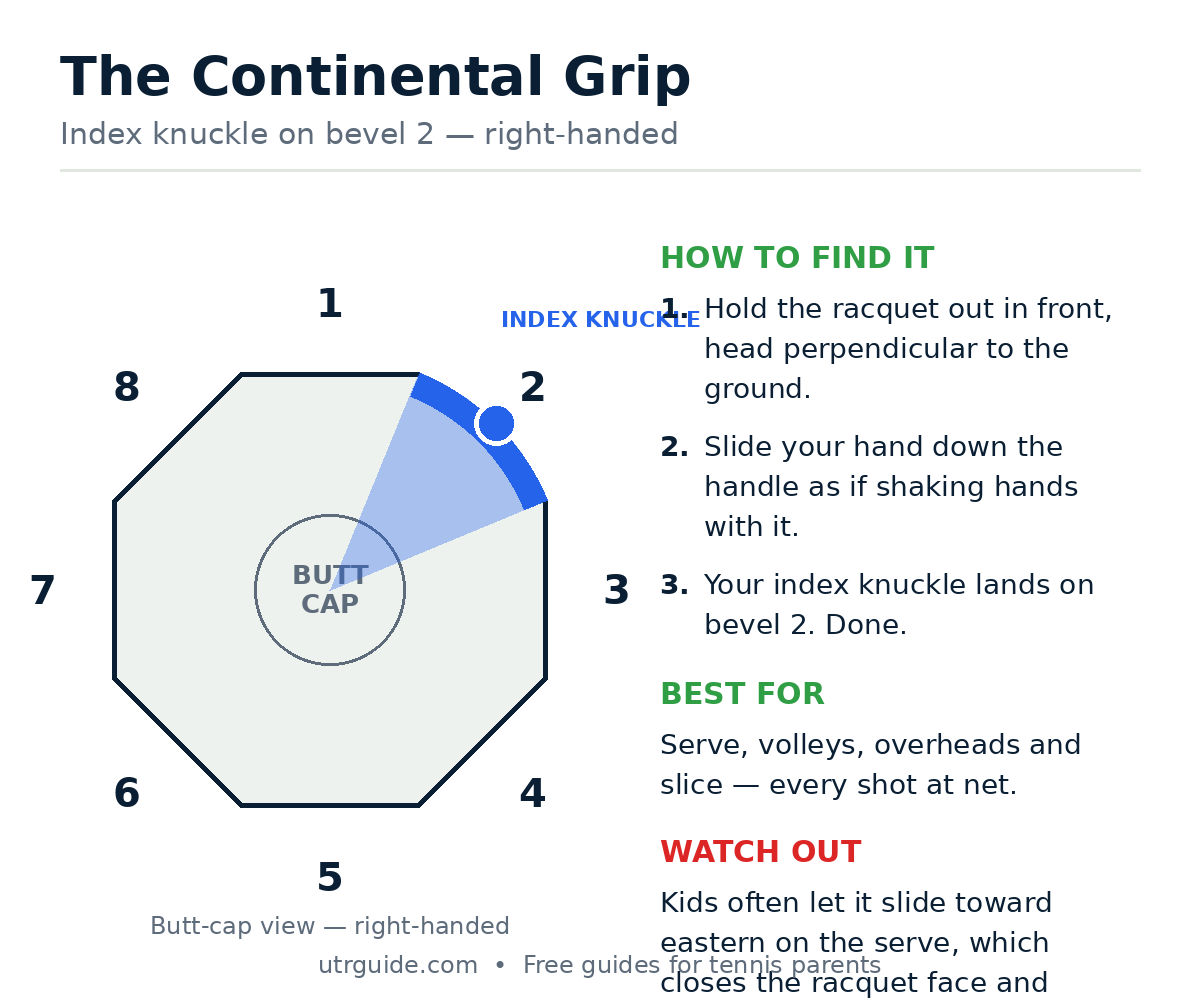
Hold the racquet out in front with the head perpendicular to the ground. Now slide your dominant hand down the handle exactly as if you were shaking hands with it. Your index knuckle lands on bevel 2. That’s the continental grip. It should feel neutral — like the racquet is an extension of your arm, not twisted one way or the other.
The classic test: hold the grip and tap the racquet face with your other hand. If the face feels vertical and stable with no wrist strain, you’re there.
Everything it does
Serve. The continental grip lets the wrist pronate naturally through contact — that’s where serve power and spin actually come from. Kids who serve with an eastern forehand grip (extremely common) hit flat, spinless serves and wonder why the ball won’t dip into the box. If your kid’s serve is all arm and no snap, check the grip before you check anything else.
Volley. At net there’s no time to change grips between forehand and backhand volleys — and with continental, you don’t have to. One grip covers both sides. A kid volleying with a forehand grip has a decent forehand volley and a backhand volley that’s pure survival.
Overhead. Same mechanics as the serve, same grip. Non-negotiable.
Slice (both sides). The continental grip opens the face slightly, which is exactly what a slice needs. Backhand slice with an eastern backhand grip works too, but continental is the universal version.
Drop shot. Touch shots live in continental.
Why kids resist it
Three reasons, all understandable. First, it feels weak at first — there’s less palm behind the handle than a forehand grip, so kids describe it as “holding a hammer wrong.” Second, nobody drills it — forehands are fun, volleys are not, so the grip never gets reps. Third, the serve is the only shot most kids hit with it, and serves get maybe 10% of practice time. Low reps plus weird feel equals a grip that never becomes automatic.
How to actually build it (parent-friendly drills)
- The handshake check: Before every practice, have your kid show you the grip and name the bevel. Ten seconds, zero nagging, builds the habit of checking.
- Volley-volley: Stand close and just volley back and forth — no groundstrokes allowed. The only way to survive is continental, and the reps pile up fast.
- Serve +1 with a target: Practice serves with the explicit goal of feeling the wrist “turn over” (pronate). If the wrist can’t turn, the grip has slipped — instant feedback.
- One-grip games: Play short-court games where every shot must be continental — volleys, slices, drop shots. Kids learn fastest when the game forces the grip.
The #1 continental mistake
Grip creep on the serve. The kid sets up continental, then during the toss the hand rotates toward an eastern forehand grip — usually because it feels more powerful. The tell: serves go flat and long, or the kid starts “pushing” the serve in. Fix it with the handshake check before every single serve in practice until the setup is boring and automatic.
The bottom line
A junior with a great forehand and no continental grip is a baseline-only player — and junior tennis increasingly punishes one-dimensional games. The continental grip is the cheapest upgrade in tennis: no new racquet, no fitness program, just a hand position and a few weeks of deliberate reps. Check the bevel, drill the volleys, and protect the serve setup. That’s the whole project.
Want a second opinion on your kid’s serve grip? Our free Virtual Coach analyzes a 10-second serve video and flags grip issues automatically.


Leave a Reply