If you’ve ever watched your kid pick up a racquet and wondered is that hand even in the right place? — this guide is for you. A tennis grip is simply where the hand sits on the handle, and it quietly decides what shots are easy and what shots are nearly impossible. The good news: you don’t need to memorize anything complicated. There are only a handful of grips that matter for juniors, and you can learn to spot every one of them in about two minutes.
The bevel system: how coaches talk about grips
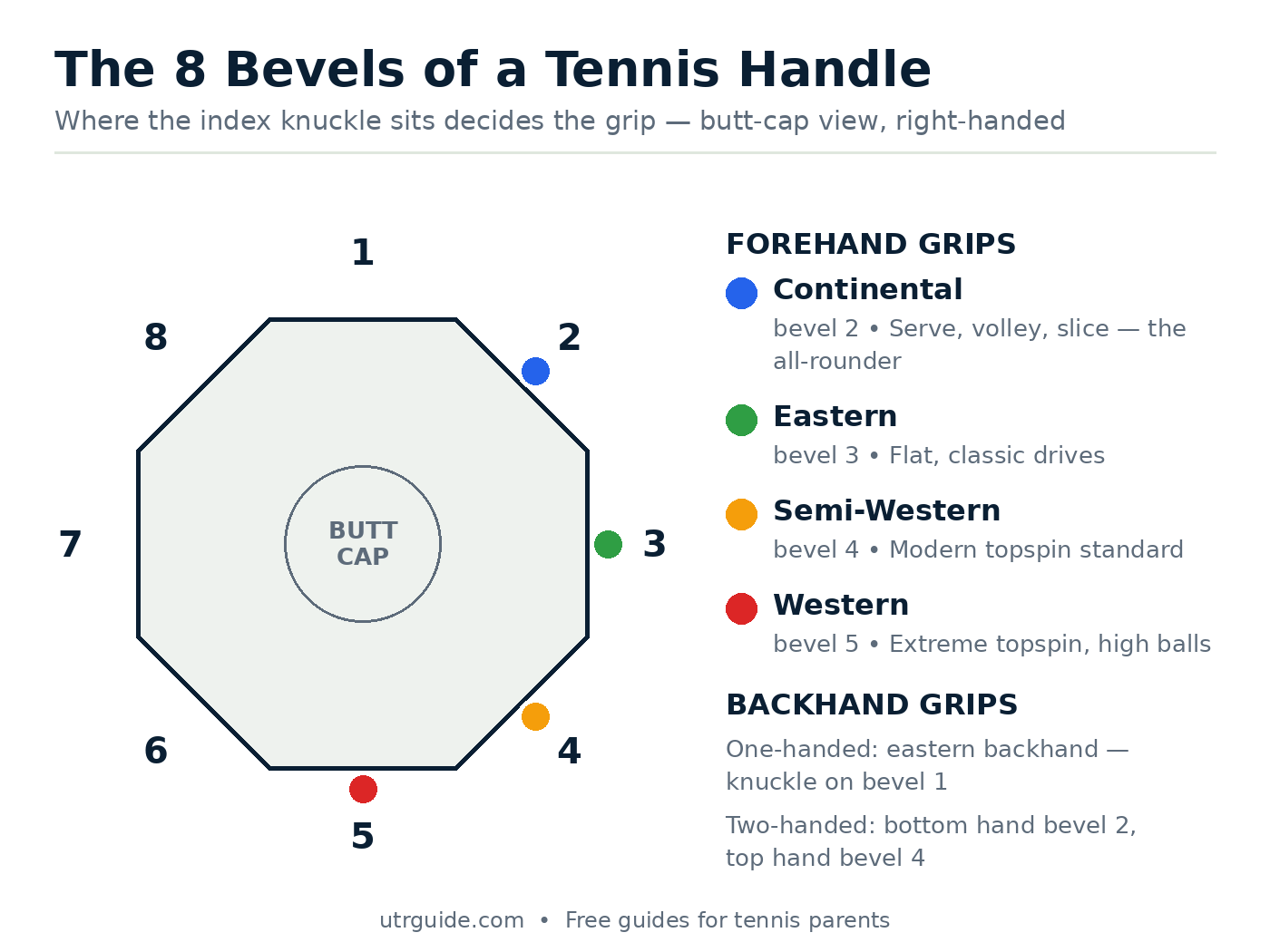
Look at the end of any tennis handle and you’ll see it’s an octagon — eight flat edges called bevels. Coaches number them 1 through 8, starting with bevel 1 on top and going clockwise (for a right-handed player). The grip is defined by one thing: which bevel the index knuckle sits on. That’s it. Once you know the bevels, you can identify any grip from across the court.
The four forehand grips
Every forehand grip is a trade-off between flat power and topspin. Here’s the full spectrum, from the most conservative to the most extreme:
Continental (bevel 2). The “handshake” grip — hold the racquet out and slide your hand down as if shaking hands with the handle. It’s the grip for serves, volleys, overheads, and slices. Every junior needs it, and most kids under-learn it because forehands are more fun to practice. Full continental guide →
Eastern forehand (bevel 3). Pick the racquet up flat off a table and you’ve found it. Flat, penetrating, classic — this was the standard for generations. Great first grip for young beginners because the racquet face is naturally square at contact.
Semi-western (bevel 4). The modern junior standard. The palm sits more under the handle, which makes heavy topspin natural. If your 12-year-old hits with big shape and margin, this is almost certainly their grip. Compare all three →
Western (bevel 5). Palm fully under the handle, racquet face closed. Extreme topspin on high balls — devastating on clay, awkward on low skidding balls. Powerful but demanding; not where most kids should start.
The backhand grips
Two-handed backhand: the bottom (dominant) hand holds continental (bevel 2) while the top hand holds a semi-western forehand (bevel 4). Hands touching, no gap. This is what the vast majority of juniors play.
One-handed backhand: an eastern backhand grip — index knuckle on the top bevel, bevel 1, thumb diagonally behind the handle. Beautiful, versatile, and it demands early preparation.
Does the grip actually matter that much?
Yes — more than almost any other technical detail at the junior level. A kid trying to volley with a semi-western forehand grip is fighting physics on every ball. A kid serving with an eastern forehand grip will struggle to get spin and placement. The grip doesn’t have to be perfect, but it has to be in the right family for the shot. When something looks technically “off” in your kid’s game, check the grip first — it’s the cheapest fix in tennis.
What about lefties?
Mirror everything. The bevel numbers run counterclockwise for left-handed players, but the hand positions and “how to find it” cues are identical — just flip the images in your head.
Keep exploring the Grips section
- How to find your kid’s forehand grip in 60 seconds
- Semi-western vs western vs eastern: which is right for your junior?
- The continental grip: the one grip every junior must learn
- 5 grip mistakes that quietly cap a junior’s game
Want an AI coach to check your kid’s grip from a 10-second video? Try our free Virtual Coach — it spots grip issues and gives three practical fixes.


Leave a Reply